What is bespoke software? A plain-English guide for SMEs
“Bespoke” sounds expensive and vague. This guide says what it means, how it differs from the software you can buy today, who it suits, and what it typically costs.
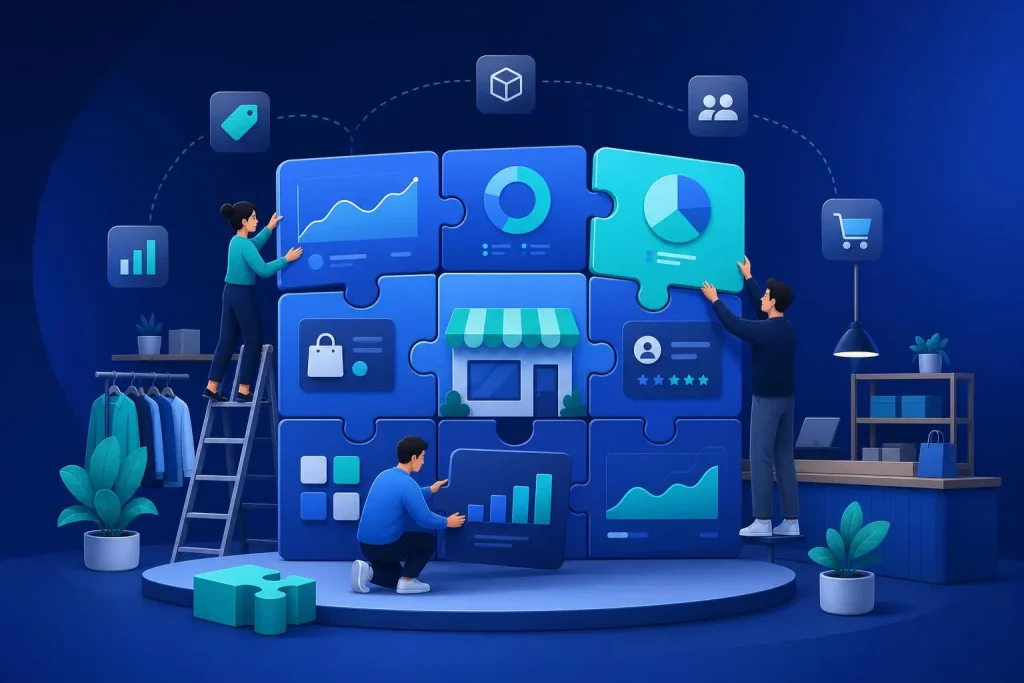
The idea in one picture
Think of a suit. Off-the-shelf software is a suit from the rack: fine for most people, wrong in a few places, and you alter your posture to suit it. Bespoke software is made to your measurements.
That is the whole concept. Someone sits down with how you really work, builds a tool around it, and hands it over. No features you didn’t ask for, and none of the ones you need missing.
How it differs from off-the-shelf software
| Off-the-shelf | Bespoke | |
|---|---|---|
| Who it’s designed for | Thousands of businesses at once | Yours |
| How you pay | Subscription, usually per user | One fixed build price |
| Fit | You adapt your process | It follows your process |
| Ownership | You rent access | You own it |
| Changes | You get what the vendor ships | You decide what gets added |
| Time to start | Immediate | Weeks, after discovery |
Neither wins every time. If a ready-made tool does 90% of what you need and the other 10% is irrelevant, buy it. Bespoke earns its place when the gap is where your business makes its money.
What bespoke software looks like in real life
It rarely looks like “software”. It looks like the job getting easier. Here are the forms it commonly takes.
Operations platform
Orders, stock and purchasing from every sales channel in one place, with accounts updated automatically.
Custom CRM
Customer records and workflows shaped around your sales process rather than a generic funnel.
Client app
A private app where customers order, chat and see their own records, instead of phone calls and spreadsheets.
Integrations
Small, quiet systems that pass data between the tools you already use, so nobody retypes anything.
OrderHub: four companies, one dashboard
A group of four limited companies sold through web, eBay, Etsy and Amazon. Orders, purchasing, stock takes and tills all lived in different places, and the same data was typed in two or three times.
We built ASD OrderHub: one dashboard covering orders, purchasing, stock takes, point of sale, staff and tasks, connected to ShipStation and Xero. Four companies, one dashboard, zero double entry.
You could not buy that off a shelf, because the combination of four companies and four sales channels was specific to them. That is the typical bespoke case: not a clever idea, just an awkward set of facts that no standard product covers.
What it costs, and what you are paying for
Our bespoke software and custom CRM builds are fixed-price, in the range of £3.5k to £9.5k. Where you land in that range depends on how many screens and users there are, how many other systems it has to connect to, and how much existing data has to move in.
Fixed price means the number is agreed before we start. Open-ended hourly billing is where bespoke projects get their bad reputation, so we don’t work that way.
Beyond the build, expect hosting and ongoing support. Anyone who says software needs nothing after launch is selling you something. The difference is that these costs are modest and predictable, not per person per month.
Got a process that no software fits?
Describe it in the project questionnaire and we will tell you honestly whether it is worth building.
See bespoke software Book a free callWho it suits, and who it doesn’t
Bespoke software is a good fit when:
- You are working around your software with spreadsheets, copy and paste, or WhatsApp.
- Your team is growing, and per-user fees are climbing with it.
- You sell through several channels, or run several companies, and need one view.
- Your process is a competitive advantage and generic software would flatten it.
It is not a good fit when a standard tool already does the job, when your process is still changing every month, or when you want to try an idea cheaply. In those cases, start with something off the shelf. It is a cheaper way to learn what you need, and if you are weighing a customer system specifically, our CRM for small business guide covers that decision.
How a bespoke project runs
- Discovery. We learn how the work really happens, including the awkward bits. This is where most of the value comes from.
- Prototype. You see something clickable early. For the Bluestone agricultural app, we went from discovery to a signed-off prototype in five working days.
- Build. The real system gets built, with your feedback along the way.
- Data move and testing. Your existing records are imported and checked against the old system.
- Launch and training. Your team starts using it, with us on hand for fixes.
The honest downsides
Bespoke software has real trade-offs, and you should hear them before you spend anything. It takes longer to start than a subscription, because someone has to understand your process first. It needs you to give time in discovery and testing, which is harder than it sounds in a busy week.
You also take on responsibility. When you own the system, you need someone to host it, back it up and fix it. That support is modest, but it isn’t zero.
Finally, a bespoke system is only as good as the thinking behind it. If your process is a mess, software will automate the mess. Part of a good discovery is simplifying the work before building anything, and sometimes that alone solves half the problem.
What to ask a developer before you hire
Ask who owns the code when it is finished. Ask what happens if you want to move to another developer later. Ask for a fixed price, a written scope, and an example of something similar they have shipped.
A good developer will answer all of those without hesitation. One who dodges them is telling you something about how the project would go.
Frequently asked questions
What does bespoke software mean?
It means software made for one organisation’s specific needs, rather than a product sold to many customers. It is also called custom or tailor-made software.
Is bespoke software better than off-the-shelf?
Only when your needs are specific and a standard product leaves a gap that costs you time or money. For standard needs, off-the-shelf is cheaper and faster to start.
How much does bespoke software cost in the UK?
Prices vary widely between suppliers. Our fixed-price builds start at £3.5k and go up to £9.5k, depending on scope. Always get a fixed price in writing.
Do I own bespoke software once it’s built?
You should. Ours is 100% owned by you, with no per-seat fees. Check ownership and code access in any contract before you sign.
How long does it take to build?
It depends on size, but a focused system is weeks rather than months. A working prototype comes first, so you can see progress early.
See if bespoke is worth it for you
Talk us through the problem and we will say whether to build it, buy it, or leave it alone.
Book a free 30-minute call See our prices