Bespoke software examples: 7 real systems small firms use
It is hard to judge whether custom software is for you from a definition. Here are seven concrete systems, four we built and three common types, with what each one replaces and what it costs to think about.
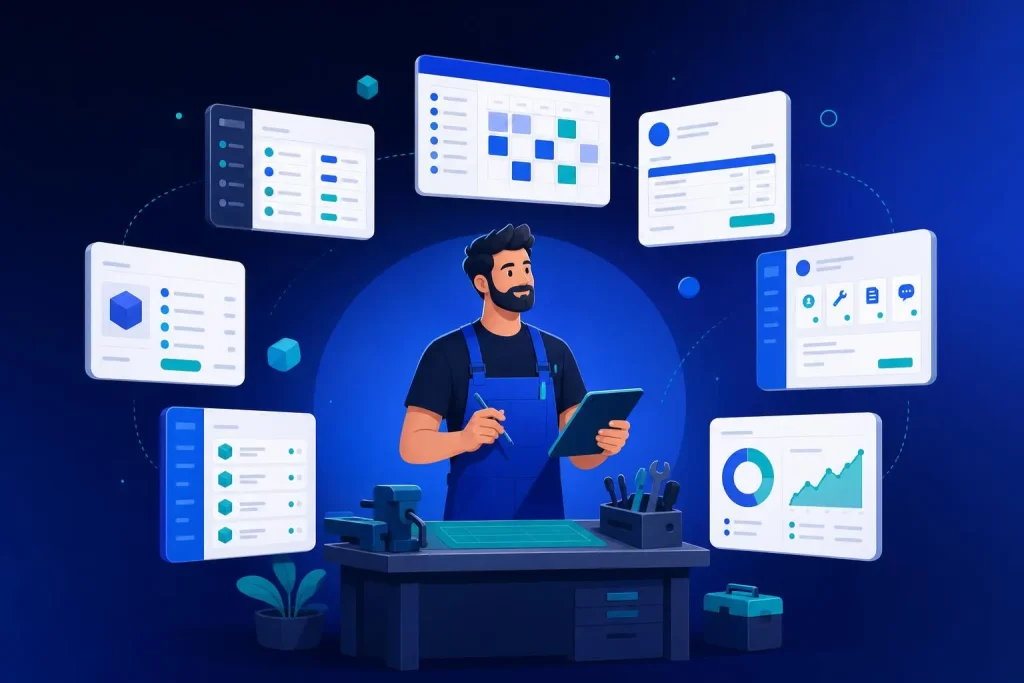
How to read these examples
Four of these are systems we built or run ourselves, and we’ll link the full case studies. The other three are common types of custom system that small firms ask about. We will say plainly which is which, so you can tell proof from illustration.
For each one, ask yourself the same question: is there a job in my business that looks like this? If so, there may be a build worth costing. If you are new to the idea, start with our plain-English guide on what bespoke software is.
1. An operations platform for several companies
A group of four limited companies sold on their own website, eBay, Etsy and Amazon. Each channel had its own orders, stock and routines, and the same data was entered more than once.
We built ASD OrderHub. It handles orders, purchasing, stock takes, point of sale, staff and tasks, with ShipStation and Xero connected. Four companies now run from one dashboard, with zero double entry.
Who it suits: anyone selling through several channels or running more than one company, where stock and money have to line up. See also our multi-channel order management service.
2. A closed-access client app
An agronomy practice in East Yorkshire ran on spreadsheets, phone calls and WhatsApp groups. Orders got lost, and field records lived in different places.
The Bluestone Agricultural App is a mobile-first, closed-access app with ordering, in-app chat and field records. It automates Xero and supplier tasks, uses magic-link sign-in, and is multi-tenant. We went from discovery to a signed-off prototype in five working days.
Who it suits: any firm with regular customers who order, ask questions and need records, from clinics to wholesalers.
3. A live supplier stock and price sync
Our own retailer, Airsoft Direct, has more than 20,000 live products. Stock and prices sync from five supplier sites, so the shop shows what can really be sold.
Orders flow straight into OrderHub, and pages are cached to serve in under 0.2 seconds. Doing that by hand would be a full-time job, and it would still be out of date by lunchtime. Our WooCommerce supplier sync page covers how it works.
Who it suits: retailers who dropship or rely on supplier stock and are tired of overselling.
4. A product builder that makes the production file
Our own gift brand, Unlicensed Labs, lets customers design a label in a live builder with eight layouts. Every order produces a print-ready 50×30mm PDF automatically, so nobody retypes names into a design file.
The site has more than 300 products and instant search that responds in about 75ms per keystroke. In a lab test, mobile performance went from 57 to 89.
Who it suits: anyone selling personalised products, where the customer’s choices have to become a production file without a person in the middle.
See your own job in one of these?
Describe it in a short questionnaire and we will tell you honestly whether it is worth building.
Start the project questionnaire Book a free call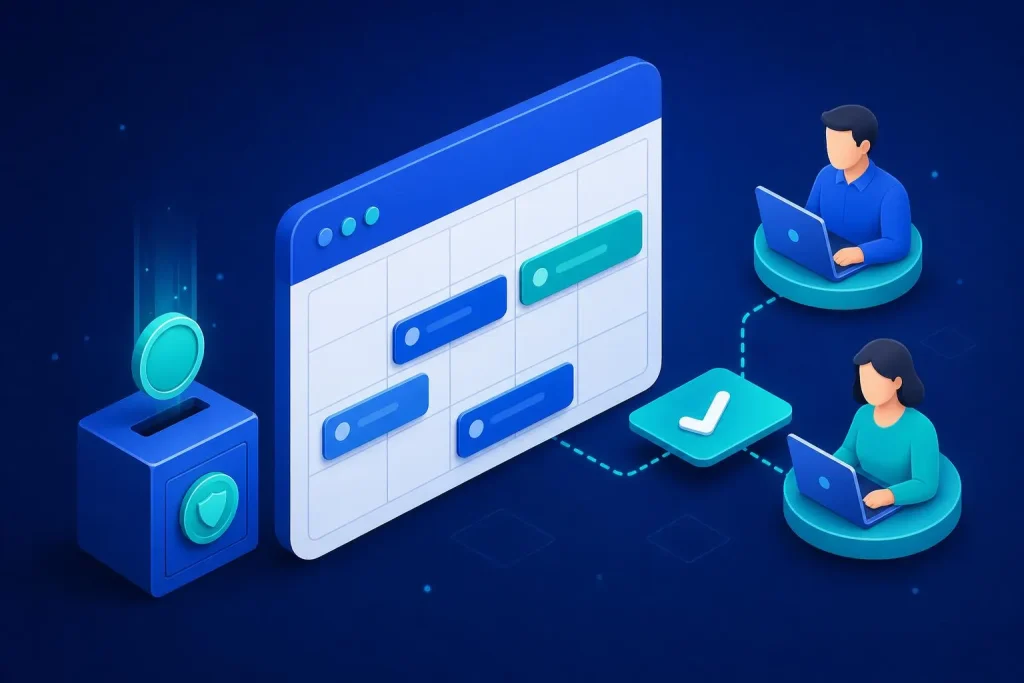
5. A booking and scheduling system
This is a common type rather than one of our case studies. Plenty of firms are bent out of shape by a booking tool that almost fits: it can’t handle a particular type of appointment, a deposit rule, or two people needed for one job.
A custom booking flow sits on your website, follows your rules, and writes straight into your calendar and payments. For a standard salon or one-person service, an off-the-shelf tool is usually the better buy. Custom earns its place when your rules are unusual.
6. A quoting tool
Another common type. If you quote from a spreadsheet of prices and rules, with the answer depending on size, material, distance or options, a quoting tool can capture those rules once and apply them every time.
The gain is speed and consistency. Quotes go out in minutes rather than the next day, and two people won’t give two different prices for the same job. It can also hold the quote history, which turns into a simple record of what you won and lost.
7. A customer portal
The third common type: a private area where customers log in to see their orders, documents, invoices or progress, instead of emailing to ask.
It cuts down on “where is my order?” calls and gives customers something they value, which is being able to look for themselves. Magic-link sign-in, as in the Bluestone app, means no passwords to forget.
What these examples have in common
A repeated job
Something done daily or weekly, not once a quarter.
Several systems or people
Data crossing from one place to another by hand.
Rules unique to you
A price rule, a workflow or a format no standard tool supports.
A cost that grows
More orders, more staff or more channels make the manual way worse.
What would not be worth building
It helps to know the other side. A custom system is rarely worth it for a task done once a month, for a process that is still changing, or where a cheap standard tool already does 95% of the job.
It is also a poor idea to build something just because it sounds impressive. The best projects start with a boring, specific pain: “we retype every order twice” or “nobody knows what stock we really have”. If you can state your problem that plainly, you are ready to talk to someone. If you can’t yet, a few weeks of noting where time goes will help a lot.
What they cost, and what to do next
We price bespoke software and custom CRM builds as fixed builds from £3.5k to £9.5k, with the price agreed before we start. Where your project sits depends on screens, users, integrations and data to import.
If one of these examples sounds close to your problem, write down the job in a paragraph: who does it, how often, what it touches, and what it costs you now in hours. That paragraph is the brief. We can then say if it fits our range, or if an off-the-shelf tool will do the job for less.
For a full view of the building blocks, see our bespoke software and custom CRM pages.
Frequently asked questions
What are some examples of bespoke software?
Order and stock platforms, custom CRMs, client apps and portals, booking systems, quoting tools, supplier syncs and product builders. All are built around a specific business’s process.
Can small businesses afford bespoke software?
Often, yes. A focused fixed-price build can cost less over three years than per-user subscriptions for a growing team. Our builds run from £3.5k to £9.5k.
How do I know if I need custom software or an off-the-shelf tool?
Try a standard tool first. If you spend your time working around it, or its fees grow with your team, a custom build is worth costing.
Will bespoke software connect to my accounting package?
It can. Both OrderHub and the Bluestone app connect to Xero, for example, so invoices and records don’t have to be typed twice.
Who owns the software afterwards?
You do. Ours is 100% owned by you, with no per-seat fees.
Have a job that looks like one of these?
Tell us what it is. We will say whether to build it, buy it, or leave it alone.
Book a free 30-minute call See our prices